Crawl Space Encapsulation Cost in Charlotte, NC
704 Crawl Space Pros is a Charlotte crawl space encapsulation company, and the figures on this page are the ones we quote from. Last updated July 22, 2026 · 8 sources cited
What crawl space work actually costs in the Charlotte metro — broken down by component, by crawl space size, and per square foot, with the source for every figure. The Charlotte-area average for a full encapsulation is about $5,100, with most projects falling between $4,200 and $13,500.
Crawl space encapsulation costs about $5,500 on average in 2026, with most projects between $1,500 and $15,000 depending on the size and condition of the crawl space.
Source: This Old House, HomeGuide and HomeAdvisor 2026 cost datasets
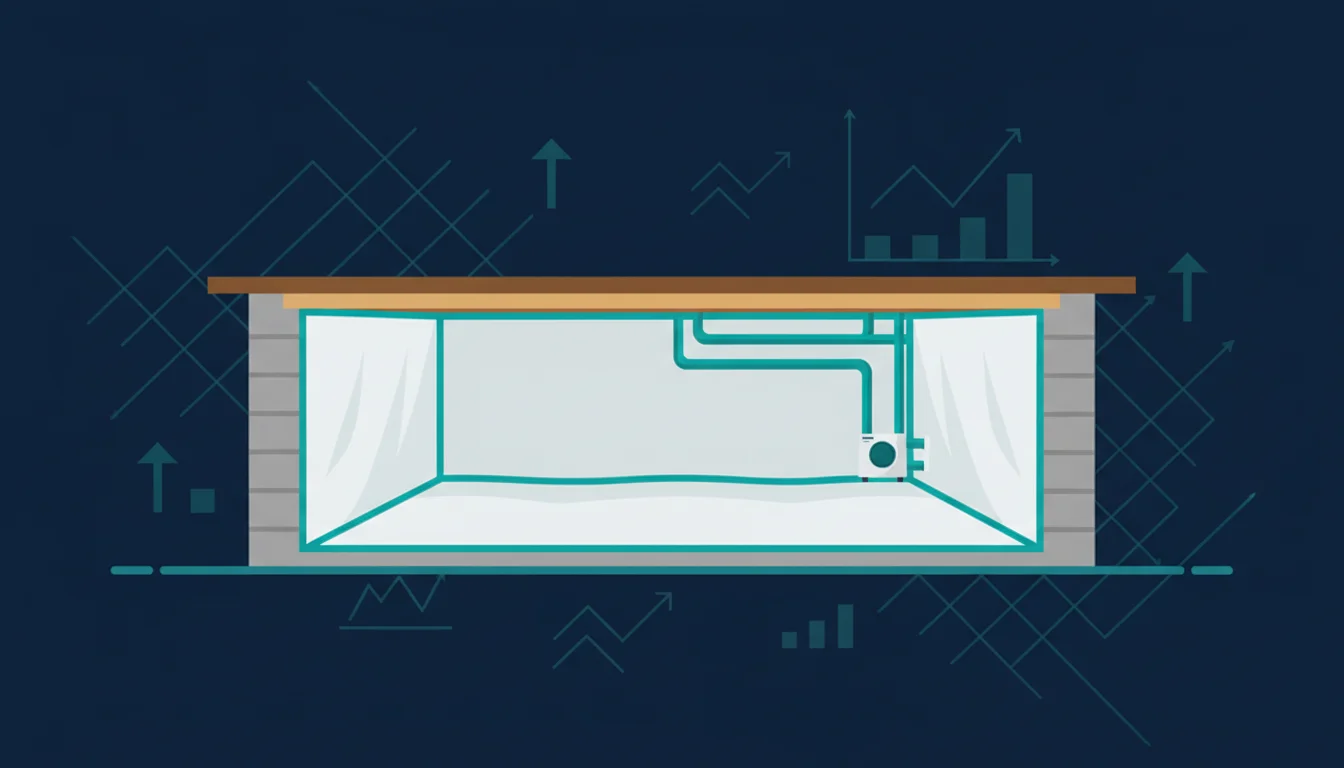
Key takeaways
- → $3–$10/sq ft Typical per-square-foot range nationally; most homeowners pay $3–$7, rising toward $10 when moisture, mold, or structural repair is involved. (HomeGuide, 2026)
- → 50–70% Share of the total that is labor — which is why local market rates move a quote more than materials do. (Angi / HomeAdvisor, 2026)
- → 15%+ Annual heating and cooling energy saved by homes on closed crawl spaces versus wall-vented ones, measured across 12 identical North Carolina homes in a U.S. Department of Energy–funded field study. (NC Advanced Energy / U.S. DOE, 2008)
- → >80% vs <65% Relative humidity in wall-vented crawl spaces through spring and summer, versus closed crawl space designs in the same NC study — against a mold-growth threshold of about 70%. (Advanced Energy, 2008)
- → 2004 The year North Carolina revised its residential code for crawl space construction, based on that Princeville field research. (Advanced Energy, 2008)
- → $2.76–$7.36/sq ft North Carolina per-square-foot range; a complete 1,200 sq ft encapsulation runs roughly $4,200–$8,800 statewide. (CrawlSpaceCosts.com, 2026)
Crawl space cost by component
“Encapsulation” is a system, and the price depends on which pieces your crawl space actually needs. Here's what each component runs in the Charlotte area, next to the independent 2026 national range for the same work — a dry, clean crawl space may need only the first three; a wet or moldy one needs more. If you're weighing a full system against just laying plastic, the difference is covered in encapsulation versus a vapor barrier.
| Component | Charlotte | National 2026 | Source |
|---|---|---|---|
| Vapor barrier (reinforced 12–20 mil) The core component. Reinforced liner sealed over the floor, walls, and piers — not the 6-mil builder sheet. | $1,500 – $4,000 | $1,200 – $4,500 | HomeGuide 2026 (F012) |
| Vent sealing Closing and sealing the foundation vents to convert the space to a closed crawl space. Most homes have 4–8 vents. | $300 – $1,000 | $150 – $600 | HomeGuide 2026 (F021) |
| Dehumidifier (installed) An energy-efficient unit sized to the square footage, with a condensate pump and drain line. | $1,200 – $2,500 | $500 – $2,000 | This Old House 2026 (F013) |
| Drainage + sump pump Only where the crawl space takes on water. Perimeter drain and a sump pump, done before the barrier. | $1,500 – $5,000 | $600 – $4,000 | This Old House / HomeGuide 2026 (F014–F016) |
| Mold removal & wood treatment Only where there's active growth. Remove, treat the wood, and dry before sealing. | $500 – $4,000 | $500 – $4,000 | This Old House 2026 (F017) |
| Full encapsulation (combined) The complete system. Charlotte-area average is around $5,100; wet or moldy crawl spaces land higher. | $4,200 – $13,500 | $1,500 – $15,000 | Multiple 2026 datasets (F001) |
Labor accounts for 50% to 70% of an encapsulation bill, which is why the same scope prices differently from one metro to the next. The two line items that swing a Charlotte quote most are the ones that are optional on paper and mandatory in practice: drainage on a crawl space that takes on water and mold remediation, which runs $500 to $4,000 on its own.
Want to put your own numbers in? The crawl space encapsulation cost calculator runs the figures on this page against your crawl space size and the components you actually need.
Comparing quotes rather than researching a number? The crawl space encapsulation service page covers what to ask any contractor near you before you book — what a quote should itemise, which liner thickness to insist on, and why two companies can price the same crawl space thousands apart.
Scale 0 – $5,000. Bars span the low-to-high Charlotte range for each component; the combined full-encapsulation total is shown in the table above.
Estimate your crawl space cost
A planning range built from the size bands below — not a quote. The condition under the house drives the real number.
Estimated range
—
Cost by crawl space size
For a full encapsulation — reinforced vapor barrier, sealed vents, and a sized dehumidifier — here's roughly how the total tracks with the size of the crawl space, before any drainage or mold work:
| Crawl space size | Full encapsulation | Works out to |
|---|---|---|
| Small — under 1,000 sq ft | $3,000 – $6,500 | $3.75 – $8.10/sq ft |
| Average — 1,000 to 1,500 sq ft | $4,500 – $9,500 | $3.60 – $7.60/sq ft |
| Large — over 1,500 sq ft | $8,000 – $15,000 | $4.00 – $7.50/sq ft |
Per square foot
There is no single per-foot price — it falls out of the table above. Across the three size bands a full Charlotte encapsulation works out to roughly $3.60 to $8.10 per square foot, with most projects landing between $4 and $7.60. That sits inside the national 2026 range of $3 to $10, where most homeowners pay $3 to $7, and brackets the North Carolina statewide figure of $2.76 to $7.36 per square foot. Note the direction of travel: small crawl spaces cost more per foot, not less — fixed setup costs (mobilization, clearing out, equipment) spread across fewer feet, which is why the under-1,000 band tops out around $8.10/sq ft while the over-1,500 band settles near $7.50. Drainage and mold work are priced as their own line items, not by the foot.
What the North Carolina research actually measured
Closed crawl spaces aren't a regional sales pitch — they were proven here. In a U.S. Department of Energy–funded field study (contract FC26-04NT42319), North Carolina Advanced Energy built and monitored 12 identical 1,040-square-foot homes in eastern North Carolina, splitting them between wall-vented and closed crawl space foundations. Three findings from that work are why the method became standard in this state:
- Homes on closed crawl spaces saved 15% or more on annual heating and cooling energy compared with the wall-vented homes.
- Wall-vented crawl spaces ran above 80% relative humidity for most of spring and summer, while the closed designs held below 65% — the threshold that supports mold growth is around 70%.
- The findings supported a 2004 revision of the North Carolina residential code governing crawl space construction, making NC one of the first states to write closed crawl spaces into code.
That humidity gap is the whole argument in one number. Charlotte sits in the same humid subtropical climate the study was run in, and a vented crawl space here spends the warm months pulling moist outside air across cool framing. If you're seeing the symptoms before the numbers, the early signs are covered in what mold in a crawl space actually looks like, and the payback case is laid out in whether encapsulation is worth it.
Source: NC Advanced Energy Corporation for the U.S. Department of Energy, 2008 (OSTI 924882). No superseding controlled field study has been published as of 2026.
above 80% for most of spring and summer
held below 65% over the same period
Dashed line marks the ~70% relative-humidity threshold that supports mold growth. Measured across 12 identical North Carolina homes — NC Advanced Energy / U.S. DOE.
What drives the price up or down
Two Charlotte crawl spaces of the same size can quote thousands of dollars apart. The difference is almost always the condition under the house, not the square footage. The factors that move the number, in roughly this order:
- Labor rates — 50% to 70% of the total, and the reason quotes vary by metro.
- Square footage of the crawl space — the base driver.
- Vapor-barrier thickness and how much wall and how many piers the liner has to wrap and seal. What that liner costs on its own is broken out in vapor barrier pricing.
- Water. A crawl space that takes on water needs drainage and a sump pump before the barrier — a significant add. If you're seeing water in the crawl space after heavy rain, start there.
- Mold. Active growth means removal and wood treatment, plus hauling out contaminated insulation and debris.
- Access and clearance. A tight, low crawl space is slower, harder work than a tall one.
Humidity control is the piece most often cut to hit a lower number, and it's the piece the NC research says does the work — whether your encapsulated crawl space needs a dehumidifier goes through when it's genuinely optional. The failure modes when corners get cut are collected in common encapsulation problems.
Why we don’t quote sight-unseen
Because the condition under the house drives the price more than anything you can measure from a floor plan, an honest crawl space quote comes from going under the house and looking. We check the moisture, the wood, the grade, and any standing water in person, then put a written, itemized scope in your hand — barrier, vent sealing, dehumidifier, and any drainage or mold work each on its own line, so you can see exactly what you're paying for. A phone quote for a crawl space is a guess. We work across the Charlotte metro, including Huntersville and Matthews.
Get a free, itemized crawl space quote in Charlotte → (704) 751-4383
How we put these numbers together
Charlotte figures come from local project scopes. Every national figure on this page is taken from an independent 2026 cost dataset — This Old House (updated March 2026), HomeGuide, Angi, and HomeAdvisor — and cross-checked between them; where two sources disagreed, the page shows the combined range rather than picking one. Research date: July 22, 2026. Sources consulted: 19; cited: 8. The energy and humidity findings come from U.S. Department of Energy–funded field research published in 2005 and 2008; it is retained because no superseding controlled field study exists and it remains the basis of North Carolina's crawl space code. Claims we could not trace to a primary source — including the widely repeated “encapsulated homes sell for 5–10% more” figure — were left out. This page is reviewed annually or whenever new NC field research or a code revision publishes.
Frequently asked questions
How much does crawl space encapsulation cost in Charlotte?
Most full encapsulations in the Charlotte metro run $4,200 to $13,500, with a typical project near $5,100. Nationally the 2026 average is about $5,500. A simple reinforced vapor barrier on its own runs $1,500 to $4,000; adding sealed vents and a dehumidifier brings it up to a full encapsulation. Crawl spaces that need drainage, a sump pump, or mold remediation first land at the higher end.
How much does crawl space encapsulation cost per square foot?
Across the three size bands, full encapsulation in the Charlotte area works out to roughly $3.60 to $8.10 per square foot, with most projects between $4 and $7.60. That sits inside the national 2026 range of $3 to $10, where most homeowners pay $3 to $7, and brackets the North Carolina statewide figure of $2.76 to $7.36. Small crawl spaces cost more per foot, not less, because fixed setup costs spread across fewer square feet.
How much does it cost to encapsulate a 1,000 sq ft crawl space?
A 1,000-square-foot crawl space sits at the bottom of the 1,000–1,500 sq ft band, so the full system — reinforced vapor barrier, sealed vents, and a sized dehumidifier — runs about $4,500 to $9,500, with a dry, clear, easy-access space landing near the low end. Add drainage and a sump pump if it takes on water ($1,500 to $5,000 more), or mold removal if there's active growth ($500 to $4,000 more).
Is crawl space encapsulation worth it?
In a U.S. Department of Energy–funded field study of 12 identical North Carolina homes, houses built on closed crawl spaces saved 15% or more on annual heating and cooling energy versus wall-vented ones. The same research measured vented crawl spaces above 80% relative humidity through spring and summer, while closed designs stayed below 65% — under the roughly 70% threshold that supports mold growth.
Does an encapsulated crawl space need a dehumidifier?
In the humid Charlotte climate, usually yes. Sealing alone does not guarantee humidity stays under the roughly 70% mold threshold, and the North Carolina field research paired the sealed liner with humidity-control strategies. A crawl space dehumidifier runs $500 to $2,000 installed nationally, and $1,200 to $2,500 here.
What drives the cost of a crawl space encapsulation up or down?
Labor is 50% to 70% of the total, so local rates matter more than materials. Beyond that: square footage; vapor-barrier thickness and how much wall and how many piers it must wrap; whether the space needs drainage before the barrier; whether there's mold to remove; and access and clearance. A clean, dry, high-clearance crawl space is the low end; a wet, moldy, low one is the high end.
What is the average cost to encapsulate a crawl space?
The average cost to encapsulate a crawl space nationally is about $5,500 in 2026, with most projects between $1,500 and $15,000. In the Charlotte metro the average crawl space encapsulation cost lands near $5,100, inside a $4,200–$13,500 range. Average is a weak guide on its own, though — the same house can sit at either end depending on whether the space needs drainage or mold work first, which is why the component table above matters more than any single average figure.
What does crawl space encapsulation cost elsewhere in North Carolina — Winston-Salem, Greensboro, or statewide?
Statewide North Carolina pricing runs roughly $2.76 to $7.36 per square foot, so a complete 1,200 sq ft encapsulation is about $4,200 to $8,800. Crawl space encapsulation cost in Winston-Salem, Greensboro and the rest of the Piedmont Triad sits close to Charlotte's, because the climate, the clay and the code requirements are the same. We work the Charlotte metro; the figures on this page are useful for comparison anywhere in the state, and the 2025 and 2026 numbers are within a few percent of each other.
How much does it cost to encapsulate a 1,000 sq ft crawl space near me?
A 1,000 sq ft crawl space sits at the bottom of the 1,000–1,500 sq ft band, so the full system runs about $4,500 to $9,500 — barrier, sealed vents and a sized dehumidifier. Add drainage and a sump pump if it takes on water, or mold removal if there is active growth. You can put your own square footage and components into the cost calculator for a range built from these same published figures.
Can I encapsulate my crawl space myself and save the labor?
Partly, and it is worth being precise about which part. A floor vapor barrier in a small, dry, high-clearance crawl space is a reasonable DIY job and saves roughly $2,000 to $4,000, because labor is 50% to 70% of a professional bill. What it does not do is finish the job — a floor-only barrier delivers about 40% to 50% of a full encapsulation, leaving the walls, vent sealing, drainage and moisture diagnosis undone. The costly mistake is sealing a crawl space without conditioning it, which traps Charlotte humidity inside; mold remediation afterwards commonly runs $2,000 to $4,000 and erases the saving. Our DIY vs professional crawl space encapsulation guide has the full cost table, the kit spec that decides whether a DIY floor lasts, and the four ways these jobs fail.
Can I get a crawl space quote for a home sale in Charlotte?
Yes, and it is one of the more common reasons people call — a crawl space finding on an inspection report, with a closing date attached. We go under the house, put the scope and the number in writing, and separate what the report actually requires from what is optional. That written scope is what you hand to the other side of the transaction.
What does a crawl space vapor barrier alone cost in Charlotte, NC?
Installed on its own, a reinforced crawl space vapor barrier runs $1,500 to $4,000 in the Charlotte metro — roughly $1 to $3 per square foot depending on thickness and how much sealing detail the space needs. That is the right scope when the space is dry and the old liner has simply failed. Once vent sealing and a dehumidifier are warranted, you are pricing an encapsulation, which is what the rest of this guide itemizes. The vapor barrier cost guide breaks the standalone job down line by line.
Sources
- North Carolina Advanced Energy Corporation. “Closed Crawl Space Performance: Proof of Concept in the Production Builder Marketplace.” U.S. Department of Energy (OSTI 924882), contract FC26-04NT42319, 2008. https://www.osti.gov/biblio/924882
- Davis, B.; Dastur, C.; Warren, W.E.; et al.. “A Field Study Comparison of the Energy and Moisture Performance Characteristics of Ventilated Versus Sealed Crawl Spaces in the South.” U.S. Department of Energy, 2005. https://digital.library.unt.edu/ark:/67531/metadc782299/
- Advanced Energy. “Closed Crawl Spaces: An Introduction for the Southeast.” Advanced Energy, Raleigh NC, 2008. https://www.advancedenergy.org/crawl-spaces
- This Old House. “How Much Does Crawl Space Encapsulation Cost?.” Updated March 13, 2026. https://www.thisoldhouse.com/foundations/crawl-space-encapsulation-cost
- HomeGuide. “How Much Does Crawl Space Encapsulation Cost? (2026).” HomeGuide, 2026. https://homeguide.com/costs/crawl-space-encapsulation-cost
- HomeAdvisor. “How Much Does Crawl Space Encapsulation Cost?.” HomeAdvisor / Angi, 2026. https://www.homeadvisor.com/cost/foundations/install-crawl-space-encapsulation/
- Angi. “How Much Does Crawl Space Encapsulation Cost? [2026 Data].” Angi, 2026. https://www.angi.com/articles/how-much-does-crawl-space-encapsulation-cost.htm
- CrawlSpaceCosts.com. “North Carolina / Charlotte Crawl Space Encapsulation Cost.” 2026. https://crawlspacecosts.com/costs/north-carolina/
Last updated: July 22, 2026
Keep reading
Explore our crawl space services
Crawl space guides
Musty air, sagging floors, or moisture under the house?
Get a free, on-site crawl space inspection anywhere in Charlotte, Concord, Gastonia, Huntersville, or the surrounding metro.